Andy Griffith’s Mind-blowing Performance in A FACE IN THE CROWD
For no reason at all, I revisit A Face in the Crowd.

Like a lot of Southerners, I grew up watching reruns of The Andy Griffith Show (1960-1968). It was a staple in our household and we watched it together as a family every night. We were particularly fond of the first five seasons and we loved the rapport between Andy Griffith’s Sheriff Andy Taylor and Don Knotts’s Deputy Barney Fife, and their adventures in the small, fictional town of Mayberry, North Carolina (based on Griffith’s hometown of Mount Airy, NC). While some of the dialogue featured in the show is a bit outdated and sexist (unfortunately common in most of the sitcoms of the 1950s and 1960s), the groundbreaking depiction of a single father and widower raising his son, overarching themes of family, loyalty and hospitality, coupled with the familiar, quirky mannerisms that are second-nature to us Southerners, really resonated with my family. And they still do, a generation later with my young daughter.
To me, Andy Griffith, and the character he created for his show (which he first debuted in an episode of the Danny Thomas series Make Room for Daddy [1953-1965]), represented so much of the goodness that can be found in the South. That goodness is so often overshadowed by the archaic, stubborn views of a few who insist on keeping the South married to its embarrassing, troubled past; and overlooked because of misunderstanding and broad stereotypes about Southern people from those outside the region’s loose borders. (As an aside, the South has a lot of work to do to improve its tarnished reputation, so it’s understandable that many people have an unfavorable view.) Andy Griffith was one of us, and he made good by representing his home with pride and dignity. He never forgot his roots and because of that, he made us proud. Griffith carefully constructed an image of a strong, principled Southern man who owned up to his mistakes while never losing sight of his moral center or succumbing to the power of his office. Sheriff Taylor was a model civil servant and elected official who respected and acknowledged that he worked for the people, and as such he had a great responsibility that he upheld at all times.
But there is another side of Andy Griffith’s acting talents, one that is in direct opposition to the folksy, wholesome images he created with his popular Andy Taylor character and later on with Ben Matlock, the always-successful criminal defense attorney in the series Matlock (1986-1995), and even in his late-career performance in the exceptional indie film Waitress (2007), written and directed by the late Adrienne Shelly. It’s a side that we’ve only seen in one performance; a side that is so dark and twisted and depraved that when compared to the image of Griffith that we know and love, it’s difficult to process and digest. And yet, it’s a brilliant, once-in-a-lifetime performance that should be considered the actor’s crowning achievement.
I’m referring to Griffith’s role as Lonesome Rhodes in Elia Kazan’s 1957 drama A Face in the Crowd.
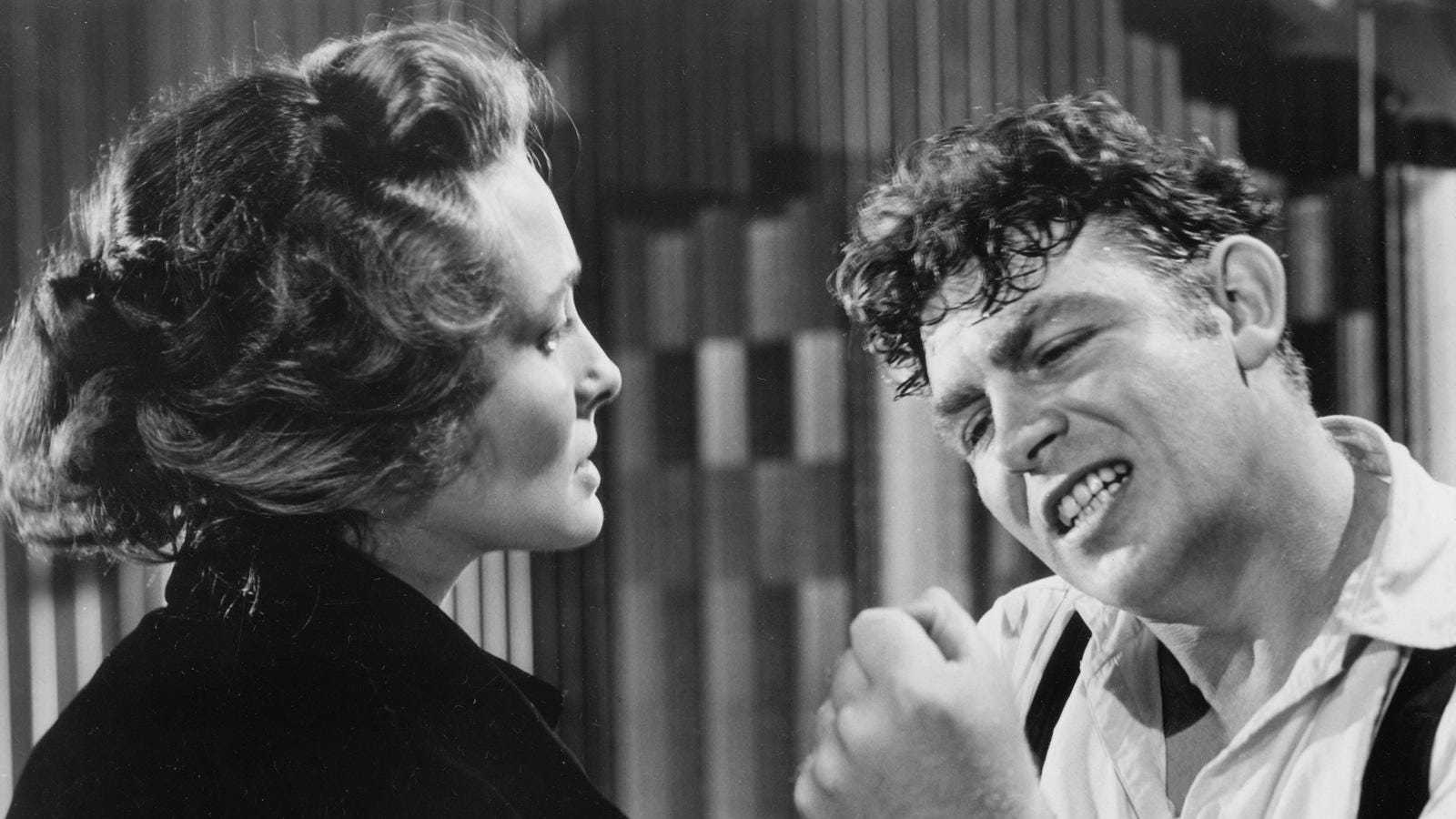
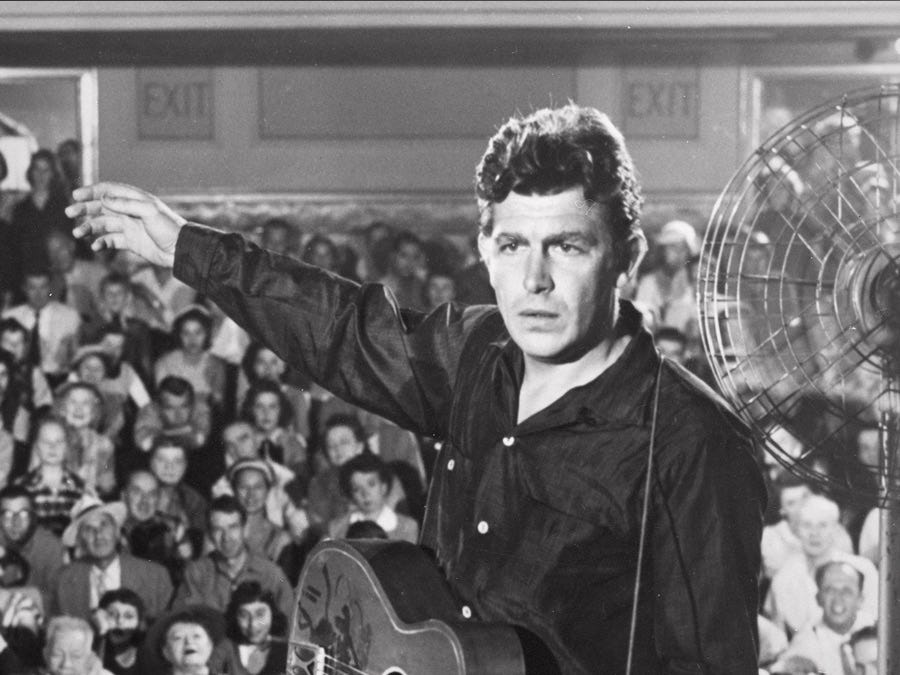
In recent years, specifically in the last couple of decades, A Face in the Crowd has been rediscovered by audiences and reevaluated by critics, with the film creeping back into cultural relevance and blowing the collective minds of anyone with a pulse. Based on a short story by Budd Schulberg, who also wrote the adapted screenplay, A Face in the Crowd is an unflinching criticism of the American public’s eagerness to blindly follow a charismatic personality, by fully buying into the manufactured brand of that personality—one composed of deceit, greed, hubris, and moral bankruptcy—while remaining blissfully ignorant to the truth. A truth that is easy to find, as it lies just under the personality’s dynamic, yet precariously fabricated image. Griffith’s Larry “Lonesome” Rhodes is a full-time drunk tank resident in a Deep South jail, whose meandering and charming tall tales impress a local radio producer, Marcia Jeffries, played by Patricia Neal. Jeffries puts Rhodes’ singing and storytelling on the radio, bestowing him with the nickname, Lonesome. He’s an overnight success, quickly making his way from the Podunk, Bumblefuck radio station to national television, with Jeffries invested as both his business partner and lover.
A Face in the Crowd follows the unexpected, yet somehow predictable, rise and fall of the dangerous cult of personality that is Lonesome Rhodes; a modern parable and cautionary tale warning us all of the predatory wolf in sheep’s clothing. A lesson that we still have yet to learn as we compulsively invest ourselves in the megalomaniac acolytes of Lonesome Rhodes. This is a film that was made over sixty years ago, but feels like it could’ve been made sixty days ago. It has never lost its relevancy or its powerful message. Matter of fact, it has gained relevance in the last six decades. And that can be directly attributed to Andy Griffith’s incredible performance.
It’s hard to believe, but A Face in the Crowd was Griffith’s film debut, and one of a very small number of theatrical films he made, as he spent the vast majority of his career on television. At the time of the film’s release, it wasn’t terribly well-received and Griffith didn’t earn the recognition that his performance deserved. No Academy Award nomination for him in a banner year for Hollywood films (David Lean’s The Bridge on the River Kwai [‘57] being the big winner that year, including a win for Alec Guinness for Best Actor), which today seems like an unforgivable oversight. But I think one of the reasons why A Face in the Crowd and Griffith’s performance is so well-received today is because of what we know about Andy Griffith as a person and the on-screen persona he created in his various television shows. We have an entire career laid before us that contradicts and even condemns and loathes the very essence of Lonesome Rhodes. Yet, Rhodes’s manufactured image is familiar and comforting. He looks like Sheriff Andy Taylor. He sounds like him. He even has that earnest, good ol’ boy quality about him that we find so endearing in Sheriff Taylor. Then there’s the masterminded bait and switch that Lonesome cleverly pulls off—at least for a time. And that’s what is so unnerving and terrifying.
I think a lot of times Elia Kazan gets too much credit for the brilliance of A Face in the Crowd. And while I’m not disputing his talents as a groundbreaking filmmaker and theater director, I firmly believe the film’s potency as a prescient commentary should be mainly attributed to Griffith’s performance, and how the trajectory of his career in the years that followed has given the film valuable retrospective context. And of course, there’s no way to plan for how a film will be received decades after its release. And it’s utterly preposterous to think that Griffith spent years playing morally grounded, likable characters just so that one day when his role as Lonesome Rhodes would be reevaluated, we’d all crumple under the weight of an existential crisis. (Believe me, I’ve thought about this as some elaborate plot, where at the end Griffith exclaims, “The Aristocrats!”) It’s more like Griffith spent the rest of his career distancing himself from Lonesome Rhodes, and maybe that’s why we never saw this side of his acting again. And honestly, I can’t say that I blame him. No one wants to be “that guy,” unless you are “that guy,” and you love being you because you’re too stupid and self-absorbed to see your impending demise. Andy Griffith’s performance in A Face in the Crowd is one of those rare gifts the universe sometimes throws our way. Sure, it’s a confusing anomaly and antithetical to everything we know to be true, with many of us honorary Mayberrians still assembling the pieces of our blown away minds—but it’s still a gift.
I believe that Andy never again wanted to play a heavy, a bad man. He certainly could have if he did. He's amazing and deserved the Oscar for sure. I wonder if Kazan's famous manipulation of his actors contributed to it. He would lie to them to get them to be jealous or angry at other actors. He would use their real life stories, issues and problems to get what he wanted. Anything for the scene, for the play or film. That said, his movies were killer, some of my faves.
He was a far more talented performer than his public image suggested. He was a devastatingly funny stand-up comic precisely because he could play so well on the gap between reality and expectation.